
Moving Through the Holidays While Moving Through Grief

The holiday season can intensify grief, even years after a loss. This time of year often brings memories, rituals, and emotions to the surface, making it hard to feel connected to joy or tradition. If you’re coping with grief during the holidays, this reflection offers gentle guidance, validation, and ways to honor what you’re carrying.
Why Grief Can Feel Heavier During the Holidays
The holidays have a way of holding a lot of complex emotions, a lightness and an ache, often in tandem. For many people coping with grief during the holidays, this season can stir memories that feel both comforting and painful. There is an air of nostalgia woven through the season: the smell of a favorite recipe, music echoing through a home or a grocery store, a particular decoration tucked away in a box that evokes memories of holidays past. These moments hold warmth and longing side by side, and they often reveal why grief can feel harder during the holidays. Because of this, the holidays are often a time when grief reminds us of its presence, highlighted against a backdrop that emphasizes joy, celebration, and connection.
The Myth of Moving On
Grief in its entirety is complex. Often, when moving through grief, we encounter pressure to move on, whether external or internal, that suggests we should get over it or let it go. Grief does not work on a timeline. We have all heard the phrase “grief is not linear”, and it’s true.
Grief does not go away, and we never reach a moment when we are simply over it.
How We Grow Around Grief (Not Away From It)
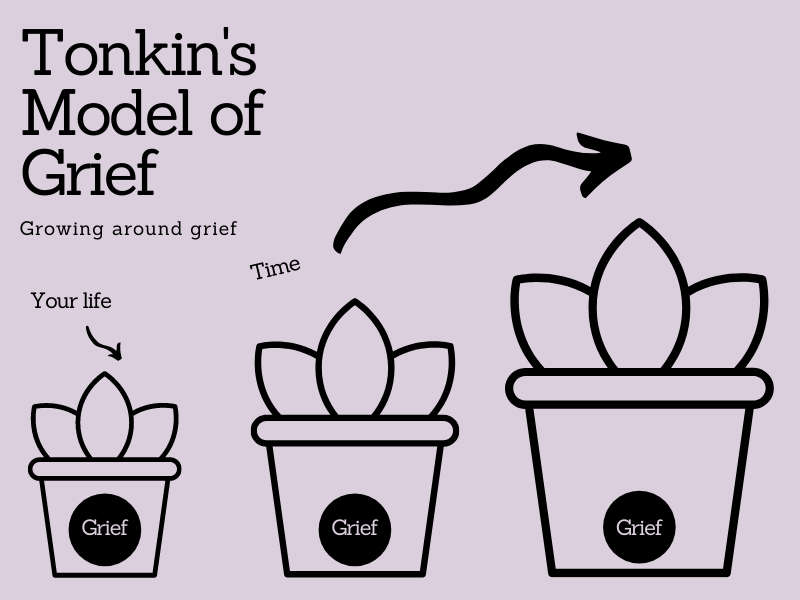
Grief counselor, Lois Tonkin, offered a model, Growing Around Grief, that feels particularly resonant: at first, grief fills our entire inner world, making it difficult to enjoy or access anything outside it. Over time, our life grows around grief. The grief itself does not shrink or disappear. Instead, it becomes part of a larger, expanding life.
This means grief may ebb and flow, no matter how much time has passed, because it remains a part of us. This is why grief resurfaces during holidays—grief becomes especially meaningful during this season as it’s a time when life temporarily becomes smaller, routines pause, and memories surface. These shifts can make the grief feel large again.
The Many Losses We Carry After Someone Dies
With the death of an important person, we often experience not just one loss, but a collection of losses. There may be the loss of the person, the loss of the life we shared with them, the loss of specific roles or rituals, and the loss of what we imagined the future would hold.
This ongoing renegotiation of life in their absence is often illuminated by significant moments such as birthdays, graduations, holidays, or death anniversaries. During the holidays, it can feel as if a spotlight is cast on the grief that has been quietly living inside us all along.
During the holidays, it can feel as if a spotlight is cast on these layers of loss, illuminating the grief triggers that live quietly inside us throughout the year.
How Grief Shows Up During the Holiday Season
Moving through the holidays while grief taps us on the shoulder, reminding us of its presence, looks different for each person. Common grief responses may show up as numbness, avoidance, irritability, overwhelm, guilt when joy arises, longing, yearning, fatigue, or a mix of many emotions.
There is no single way grief will appear and no single way to address it.
Making Space for Your Needs While Grieving
If you’ve been wondering, how to cope with grief during the holidays? There is room for many different approaches:
Allowing the grief in and holding it with tenderness.
Giving ourselves permission to lean into pockets of joy and lightness.
Honoring our capacity and energy.
Setting internal and external boundaries.
Leaning into support.
Taking time to withdraw and reflect, or doing a combination of all of these.
There is no right way to cope with grief during the holidays, and your emotions may shift from day to day.
A Personal Reflection on Grief and the Holidays
As I write this, I am aware that I struggled to start this blog for a while. This will be my eleventh holiday season without my dad, and even after all these years, grief still taps on my shoulder in its familiar way.
Upon reflection, I have caught myself having those passing thoughts of judgment about my own timeline. There have been moments when I have questioned my experience with grief and wondered why it is not smaller by now. While I do not believe grief works that way, I have learned how grief changes over time. Unlearning this idea is its own ongoing process, even for a therapist navigating her own grief. Writing this has been a gentle reminder to allow my grief to visit, to hold space for it, and to meet myself with softness as it does.
Giving Yourself Permission to Move Through the Holidays Gently
Give yourself permission to grieve—to move in whatever way honors you most. The permission to soften, permission to feel joy, permission to ache, permission to miss someone fiercely.
And whatever this holiday season brings, may you meet it with as much gentleness as you can.
If you notice yourself needing gentleness, rest, or community this holiday season, consider giving yourself permission to seek support. It’s okay to ask for help, and it’s okay to receive it.
